
An operating system for AI-developed applications.
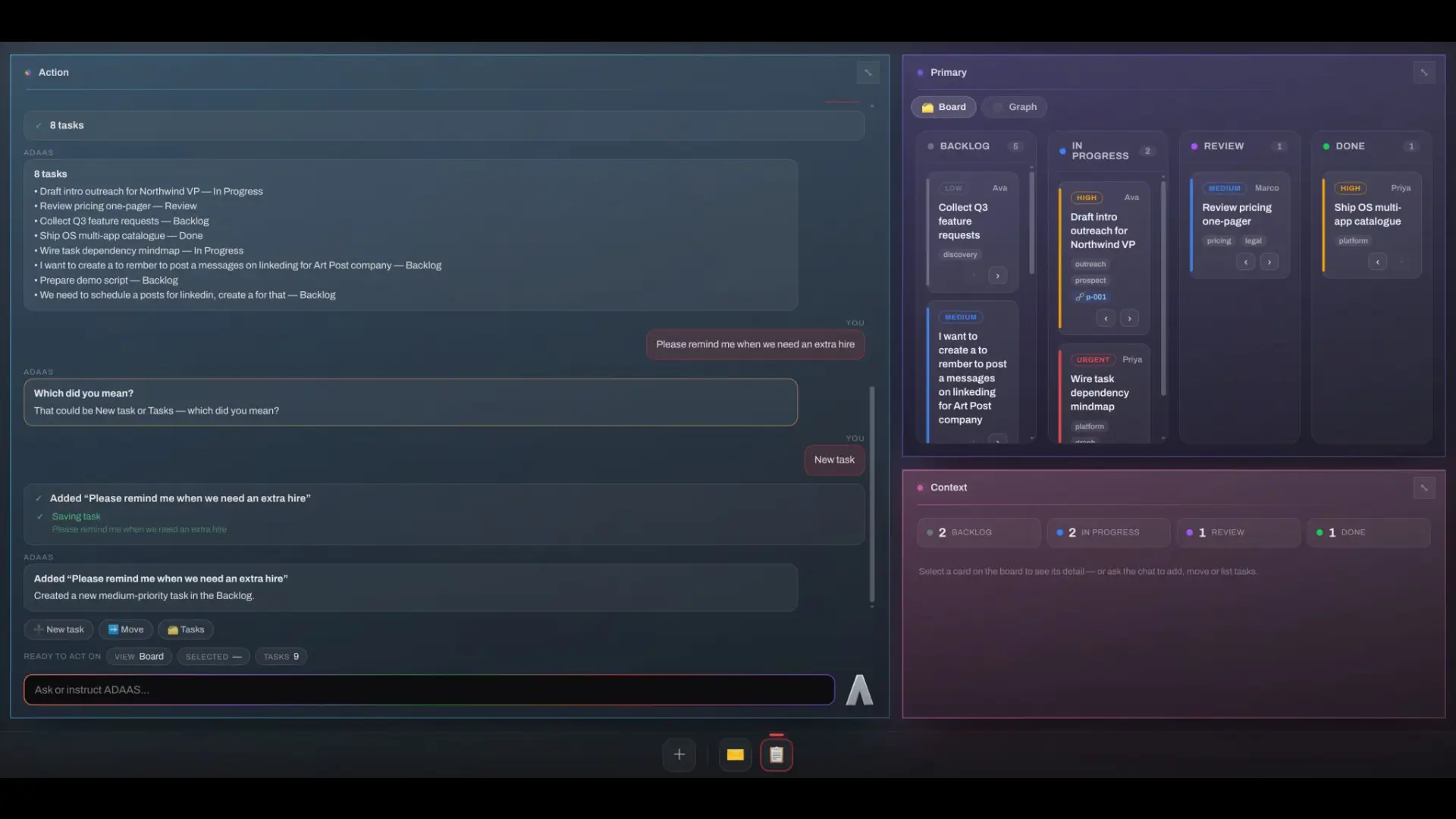
A-OS is a web-based operating environment designed to run many AI-developed applications under a unified experience. Instead of opening and managing separate applications, interfaces, and workflows, users work in a common environment where applications expose their capabilities as skills, tools, and services.
An application no longer has to be an isolated destination. It can become a capability within a larger software environment.
A-OS is part of the ADAAS Architecture Intelligence Platform — the environment where applications built with AIS Studio come to run.
The application model is changing
Traditional software is organized around applications. A user opens a CRM, an ERP, analytics, project management, finance, support, communication — each with its own interface, navigation, authentication, workflows, terminology, and data model. Users are expected to know which application contains the functionality they need.
AI changes how software is created and used. Applications can become smaller, more specialized, and far easier to create. Instead of one massive application containing every capability, organizations can have many focused applications built around specific business needs. That creates a new problem.
If software becomes a collection of many AI-developed applications, how do users interact with all of them? A-OS is designed to answer that question.
What is A-OS?
A-OS is a web-based operating environment for AI-developed applications. It provides a common shell in which multiple applications coexist while exposing their functionality through a unified interaction model. An A-OS environment can contain applications such as:
Customer Management     Portfolio Analysis     Reporting
Document Processing     Risk Analysis          Operations
Analytics               Internal Tools         Compliance
Instead of forcing users to treat each application as a separate destination, A-OS makes their capabilities available through the same environment — a shift from application-centric software to capability-centric software.
From applications to capabilities
In a traditional enterprise a single task — “prepare a risk report for this customer” — might mean opening the CRM, finding a customer, copying information, opening analytics, searching for the portfolio, opening another application, generating a report, and moving the result somewhere else. Each application operates inside its own boundary. A-OS introduces another model: a document application exposes Extract Document Data, a financial application exposes Calculate Portfolio Risk, a customer application exposes Find Customer, a reporting application exposes Generate Report. These become skills available within the broader environment.
The user interacts with the environment. The environment accesses the appropriate application capabilities.
A common environment for many applications
A-OS provides a consistent shell around AI-developed applications — a common operating layer, while allowing each application to provide its own functionality:
- application discovery
- navigation
- user interaction
- skills
- plugins
- application capabilities
- AI-driven workflows
- contextual actions
The objective is not to force every application to look identical. It is to create a balance between application independence and user-experience unification.
Why this matters in the AI era
AI dramatically lowers the cost of creating software. A specialized internal application that once required months of engineering can increasingly be built far faster — which can lead to an explosion of small applications. Instead of ten large applications, an organization could eventually have hundreds or thousands of focused, AI-developed applications. That is powerful, but without a common operating model it can also create fragmentation:
- too many applications
- too many interfaces
- duplicated capabilities
- disconnected workflows
- inconsistent experiences
- rising cognitive overhead
The answer to application proliferation is not to build one giant application. It is a unified environment in which many applications operate together.
An operating system for small AI applications
Traditional operating systems let many programs coexist, providing common services and a common environment. A-OS applies the same idea to AI-developed applications: the applications remain specialized, and A-OS provides the environment around them — designed specifically so their capabilities can be exposed, discovered, and used in an AI-native way.
| Traditional computing | A-OS |
|---|---|
| Operating system | A-OS |
| Applications | AI-developed applications |
| Files & windows | Skills & capabilities |
| User opens each program | Unified user experience |
| Programs run in isolation | Capabilities compose across apps |
Beyond the traditional application launcher
A conventional launcher answers “which application do you want to open?” A-OS answers a different question:
Not “which application?” but “what do you want to accomplish?”
A request such as “prepare a risk report for this customer” may require capabilities from several applications. A-OS provides the environment in which those capabilities work together — so the user does not need to know which application owns the capability, where the functionality lives, or which interface to open first. The system focuses on the task rather than the application boundary.
Humans and AI agents in the same environment
A-OS is built for a world where both humans and AI interact with software. A person can select a capability directly; an AI agent can invoke the same capability as part of a larger task. An agent working on a customer task might chain Find Customer → Retrieve Account → Analyze Portfolio → Generate Report → Store Report — capabilities that belong to different applications. The same application ecosystem serves both human-driven and AI-driven workflows.
Applications become composable
A traditional application is a closed product: it owns its interface and workflows and expects users to enter through its own UI. A-OS makes it possible for application capabilities to participate in workflows that cross application boundaries. A wealth-management task can flow from customer information, to portfolio risk analysis, to a final report — experienced by the user as one workflow, even though the underlying capabilities come from multiple applications. This is particularly powerful in enterprises, where business processes naturally cross system boundaries.
Customer App   →  Customer information
Portfolio App  →  Risk analysis
Reporting App  →  Final report
                    ↓
              One unified workflow
Where A-OS fits
- Financial services
- Customer, portfolio, market data, risk, reporting, and document applications live in one environment. “Show the current portfolio and prepare a client-ready risk summary” draws on each specialized app while the user’s experience stays unified.
- Enterprise operations
- Ticket management, customer records, document processing, workflow automation, and reporting are reachable through a common environment — reducing the overhead of navigating every application.
- AI-developed internal tools
- Invoice validators, contract analyzers, pricing calculators, compliance checkers, data importers, report generators — many tiny specialized apps, brought together without a single monolithic product.
- AI-native organizations
- A common operating environment for AI-developed applications and the agents that use them.
How A-OS is different
A-OS is a new category — and easy to confuse with adjacent ones. The distinctions matter:
- vs. a SaaS platform
- SaaS usually provides one application or tightly integrated toolset. A-OS is an environment where many specialized applications coexist and expose capabilities through a common experience.
- vs. a traditional OS
- Windows, macOS, and Linux run programs on hardware. A-OS is a web-based environment designed around applications whose capabilities can be exposed, discovered, and composed in an AI-native way.
- vs. an AI agent framework
- An agent framework answers “how do I build and run an AI agent?” A-OS answers “how do I run, discover, compose, and interact with a growing ecosystem of AI-developed applications and their capabilities?”
A-OS inside the ADAAS platform
A-OS is not an isolated operating system — it is part of the broader Architecture Intelligence Platform. AIS defines intent, A-Concept models the application, A-Frame composes it, AIS Studio lets people build it, and A-OS is where those applications and their capabilities live and work together. In the lifecycle Define → Build → Deploy → Run → Compose → Evolve, AIS Studio owns build and A-OS owns run and interact.
Who is A-OS for?
- Enterprises
- Bring large numbers of specialized applications into a more unified software environment.
- Product organizations
- Create and deploy focused applications without an isolated user experience for every product.
- Operations teams
- Access capabilities from multiple systems without constantly switching between applications.
- AI-native organizations
- Give AI-developed applications and agents a common operating environment.
- Developers & architects
- Build specialized applications that expose reusable capabilities to other applications and agents.
- AI agents
- Discover and interact with application capabilities through a common environment.
The future of applications
The traditional application is a destination: you open it, navigate it, perform a task, and leave. AI-native applications can be different — they expose capabilities, communicate with other applications, participate in agent workflows, are created rapidly, and specialize for a single purpose. They become components of a much larger software environment.
The operating system is no longer only where applications run. It can become the layer that makes applications work together.
Frequently asked questions
What is A-OS?
A-OS is a web-based operating environment designed to run multiple AI-developed applications under a unified user experience.
Is A-OS an operating system like Windows or Linux?
A-OS applies the operating-system concept to AI-developed applications. It is a web-based environment rather than a conventional hardware operating system.
What problem does A-OS solve?
It addresses the fragmentation that occurs when organizations have many specialized applications, providing a common environment where applications expose capabilities and participate in a unified user experience.
What are skills in A-OS?
Skills are capabilities provided by applications that can be accessed and used within the broader A-OS environment.
Can different applications work together?
Yes. A central concept of A-OS is that capabilities from different applications can participate in shared workflows and experiences.
Can AI agents use A-OS?
Yes. A-OS is designed for an environment in which AI agents can interact with application capabilities as part of larger tasks and workflows.
How is A-OS different from a SaaS platform?
SaaS typically provides a particular application or tightly integrated functionality. A-OS is an environment in which many specialized applications coexist and expose capabilities through a common experience.
How is A-OS different from an AI agent framework?
An agent framework provides infrastructure for creating and running agents. A-OS focuses on the broader environment in which applications, capabilities, users, and AI agents interact.
How does A-OS work with AIS Studio?
AIS Studio is used to create and evolve AI-native applications. A-OS provides the environment in which those applications run and participate in a unified experience.
Why is an operating system needed for AI applications?
As AI reduces the cost of creating software, organizations may end up with many more specialized applications. A common operating environment provides a way to discover, access, and compose their capabilities without requiring every application to become a standalone destination.
Go deeper
Many applications. Shared capabilities. One experience.
Build many specialized applications, give them reusable capabilities, and let humans and AI agents access those capabilities through one unified environment: applications → skills → agents → unified experience.